If you’re confused between burry and bur, you’re not alone. These words look similar, but they have very different meanings—and one is far more common in standard English usage.
In this simple, human-friendly guide, you’ll learn the difference between burry vs bur, meanings, examples, common mistakes, and an easy trick to remember the correct word.
Quick Answer
- ✔️ Bur = a prickly seed case or rough clinging plant part
- ⚠️ Burry = covered with burs or sometimes used as a name
👉 Most people usually need the word bur.
What Does “Bur” Mean?


6
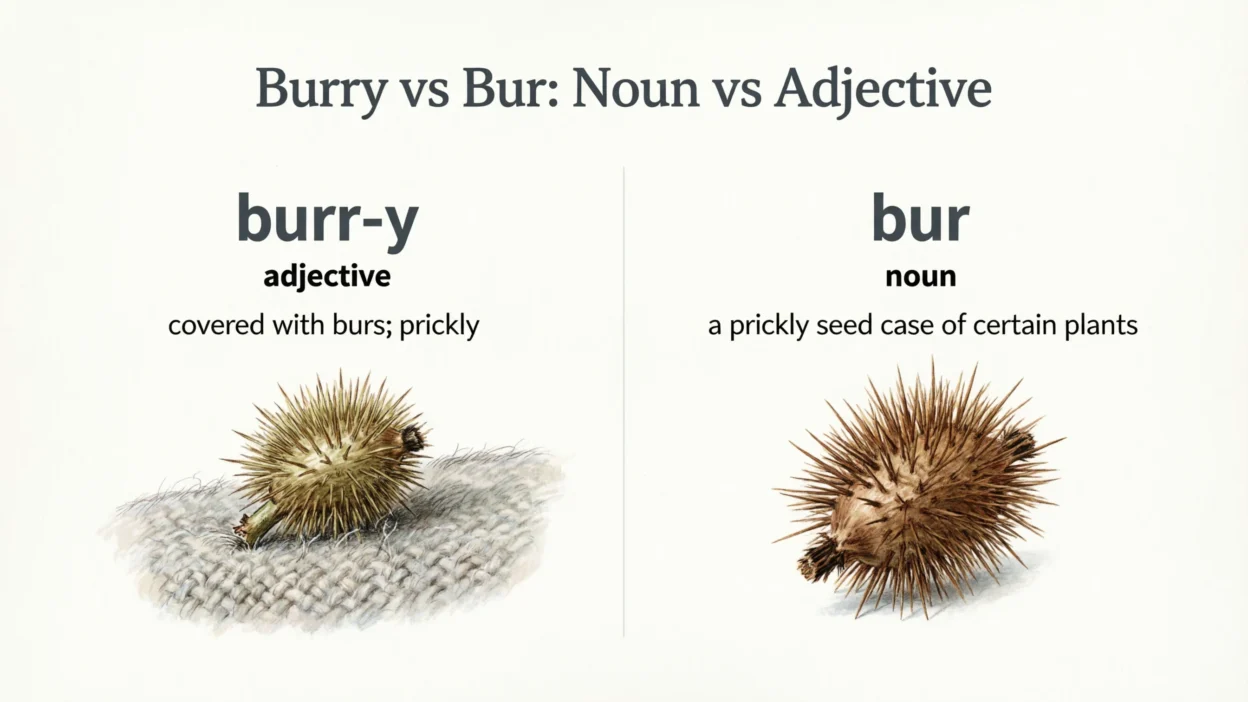
Bur is a noun that refers to:
- A rough or prickly seed covering
- A plant part that sticks to fur or clothing
Examples
- A bur stuck to my jacket.
- The dog came home covered in burs.
- She removed a bur from her sock.
👉 You may also see the spelling burr, especially in some dictionaries or technical contexts.
What Does “Burry” Mean?


6
Burry is an adjective meaning:
- Covered with burs
- Full of prickly seed cases
It is much less common than bur.
Examples
- The sheep’s wool looked burry after walking through the field.
- His socks became burry from the weeds.
👉 “Burry” can also appear as a surname or place name.
Burry vs Bur: Key Differences
| Feature | Bur | Burry |
|---|---|---|
| Meaning | Prickly seed case | Covered with burs |
| Word Type | Noun | Adjective |
| Usage | Common | Less common |
| Example | A bur stuck to my shoe | Burry wool |
Easy Way to Remember
- Bur = the actual prickly object
- Burry = something covered in burs
👉 Trick:
“Add -y to describe something.”
Example:
- cloud → cloudy
- bur → burry
Common Mistakes to Avoid
❌ Using “Burry” as the Noun
Wrong: A burry stuck to my sock.
✔️ Right: A bur stuck to my sock.
❌ Confusing “Bur” With “Bury”
- Bur = prickly plant part
- Bury = put underground
❌ Assuming Both Mean the Same
They are related but not interchangeable.
Real-Life Examples
- The child picked a bur off the dog’s fur.
- Farmers dislike sharp burs in fields.
- The blanket became burry after contact with weeds.
- Her coat looked burry after hiking.
American vs British English
There is very little difference:
- ✔️ American English commonly uses bur or burr
- ✔️ British English also recognizes both forms
👉 “Burry” remains uncommon in both.
When to Use Bur vs Burry
Use “Bur” When:
- Talking about the prickly seed itself
- Referring to weeds sticking to clothing or animals
Use “Burry” When:
- Describing something covered in burs
FAQs
1. Is “burry” a real word?
Yes, but it’s uncommon and usually means covered with burs.
2. What does “bur” mean?
It means a prickly seed case that sticks to things.
3. Is “bur” or “burr” correct?
Both are accepted spellings.
4. Is this confusion common?
Yes, because the words look similar.
5. Can burry be used as a noun?
Usually no—it’s mainly an adjective.
6. Which word is more common?
Bur is much more common.
7. What’s the easiest rule?
Bur = object, Burry = description.
Final Summary
Understanding burry vs bur is simple once you know their roles. Bur is the common noun for a prickly seed case, while burry is an adjective describing something covered in burs.
Most everyday writing uses bur, while “burry” appears much less often.

Born where forests whisper and rain writes stories on glass, Ethan Walker found meaning in silence. He writes not to impress but to express the quiet battles, unseen growth, and the beauty of becoming. His words are simple yet lasting, like echoes the heart refuses to forget.