If you’ve ever wondered whether to write stoped or stopped, you’re not alone. This is a very common English spelling mistake because of the double-letter rule.
In this simple, human-friendly guide, you’ll learn the correct spelling, why it works, examples, common mistakes, and an easy trick to remember stopped vs stoped forever.
Quick Answer
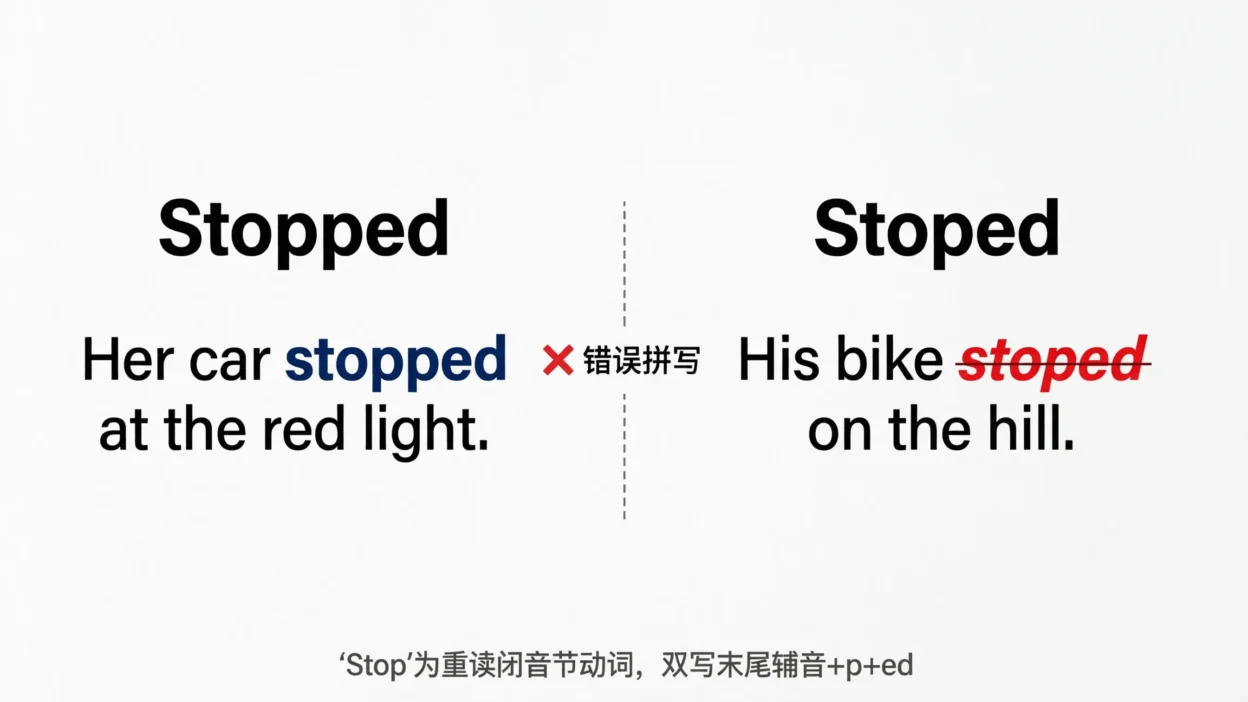
- ✔️ Stopped = correct spelling
- ❌ Stoped = incorrect spelling
👉 Always use stopped.
What Does “Stopped” Mean?


5
Stopped is the past tense and past participle of the verb stop.
It means:
- Ended movement
- Ended an action
- Prevented something from continuing
Examples
- The car stopped suddenly.
- She stopped talking.
- Rain stopped after an hour.
Why “Stoped” Is Wrong
❌ Stoped is not correct in standard English.
This mistake happens because people forget the double consonant rule.
The Double Consonant Rule
When a short verb ends in:
- consonant + vowel + consonant
👉 Double the final consonant before adding -ed.
Examples
- stop → stopped
- plan → planned
- shop → shopped
So:
- ✔️ stopped
- ❌ stoped
Stopped vs Stoped: Key Differences
| Feature | Stopped | Stoped |
|---|---|---|
| Spelling | Correct | Incorrect |
| Grammar | Proper past tense | Misspelling |
| Rule | Double final consonant | Breaks spelling rule |
| Usage | Standard English | Non-standard |
Easy Way to Remember
👉 “Stop” needs an extra p before -ed
- stop → stopped ✔️
- stop → stoped ❌
💡 Think:
“A full stop needs two P’s.”
Common Mistakes to Avoid
❌ Forgetting the Double Letter
Wrong: He stoped the car.
✔️ Right: He stopped the car.
❌ Mixing Verb Rules
Not all verbs double letters—but short verbs like stop do.
❌ Fast Typing Errors
Always check for double consonants in short verbs.
Real-Life Examples
- The bus stopped near the station.
- She stopped laughing suddenly.
- They stopped the project.
- The music stopped playing.
American vs British English
There is no difference:
- ✔️ American English: stopped
- ✔️ British English: stopped
👉 “Stoped” is incorrect everywhere.
When to Use “Stopped”
Use “Stopped” When:
- Talking about something ending
- Writing past tense of stop
- Describing halted movement or action
👉 Always use stopped, never “stoped.”
FAQs
1. Is “stoped” ever correct?
No, it is always incorrect.
2. Why does stopped have two p’s?
Because of the double consonant spelling rule.
3. What is the past tense of stop?
The correct past tense is stopped.
4. Is this a common mistake?
Yes, especially among English learners.
5. Which verbs double the final consonant?
Short verbs like stop, plan, shop, and drop.
6. Does pronunciation change?
No, pronunciation stays similar.
7. What’s the easiest rule?
Double the final consonant before adding -ed.
Final Summary
The confusion between stoped vs stopped is easy to fix: stopped is correct, and stoped is incorrect. Just remember the double consonant rule for short verbs ending in consonant-vowel-consonant patterns.
Using the correct spelling helps your writing look polished, accurate, and professional.

In a city that never pauses, Madison Blake learned to feel deeply. She turns love into lines and heartbreak into something almost beautiful. Her words reveal what many hide soft truths, loud emotions, and everything in between writing for hearts still learning how to heal.