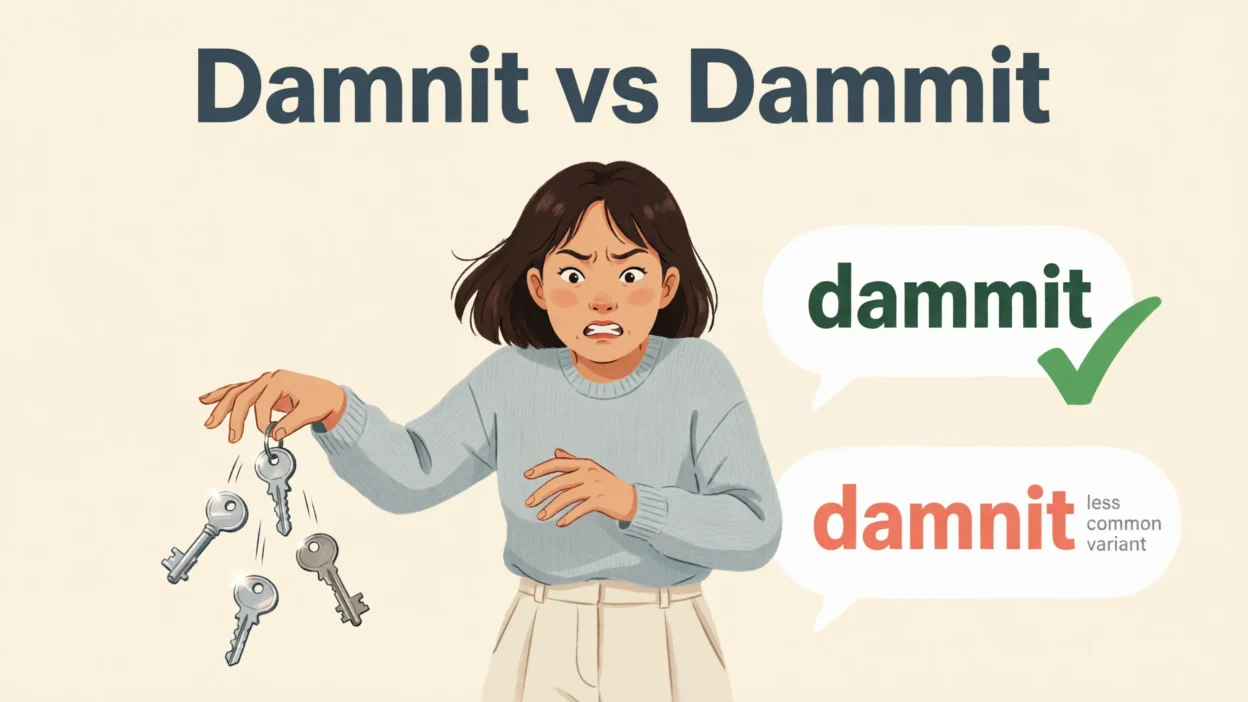
The words damnit and dammit are both informal exclamations used to express frustration, anger, disappointment, or annoyance. However, one spelling is far more common and widely accepted than the other.
If you’re wondering which version to use, dammit is generally considered the standard spelling, while damnit is a less common variant that occasionally appears in informal writing.
Quick Answer
- Dammit is the preferred and most common spelling.
- Damnit is a less common alternative spelling.
- Both express frustration or annoyance.
Examples
- Dammit, I forgot my keys!
- Dammit, the computer crashed again!
What Does “Dammit” Mean?
Dammit is an informal exclamation derived from:
- damn it
It is used to show:
- frustration
- anger
- disappointment
- irritation
Examples of Dammit
- Dammit, I missed the bus.
- Dammit, I made the same mistake again.
- Oh, dammit! My phone battery died.
- Dammit, that’s not what I wanted.
What Does “Damnit” Mean?
Damnit has the same meaning as dammit and is often used in the same way.
Examples of Damnit
- Damnit, I forgot my wallet.
- Damnit, it’s raining again.
However, this spelling is less common and less widely accepted.
Dammit vs Damnit: Main Difference
| Word | Status | Usage |
|---|---|---|
| Dammit | Standard and more common | Preferred spelling |
| Damnit | Alternative spelling | Less common |
Why Is “Dammit” More Common?
The word comes from the phrase:
- damn it
Over time, the phrase was shortened in informal speech and writing to:
- dammit
This spelling became the dominant form in dictionaries, books, movies, and everyday writing.
Pronunciation Difference
There is little to no pronunciation difference between:
- dammit
- damnit
Both are commonly pronounced:
- DAM-it
Because they sound similar, spelling confusion is common.
Is Dammit a Bad Word?
Dammit is generally considered a mild swear word or mild profanity.
Its offensiveness depends on:
- culture
- audience
- setting
Usually Acceptable In
- casual conversation
- fiction
- movies
- social media
Usually Avoided In
- formal business writing
- academic papers
- professional documents
Common Mistakes People Make
Mistake 1: Thinking Damnit Is the Standard Form
Most dictionaries and style guides favor dammit.
Mistake 2: Using Either Form in Formal Writing
Both are informal expressions.
Mistake 3: Confusing Them With “Damn It”
Remember:
- damn it = original phrase
- dammit = shortened form
American vs British English Differences
There is no major difference.
Both Commonly Use
- dammit
Less Common Variant
- damnit
Examples in Everyday Sentences
Using “Dammit”
- Dammit, I dropped my coffee.
- Dammit, the game was canceled.
- Dammit, I was so close to winning.
Using “Damnit”
- Damnit, I forgot the password.
- Damnit, I missed the deadline.
While understandable, these examples are less common than dammit.
Easy Memory Trick
Think about the phrase:
- damn it
When the words are combined, the standard spelling becomes:
- dammit
The double m helps you remember the preferred form.
Related Words and LSI Keywords
Here are related phrases connected to damnit or dammit:
- dammit meaning
- damnit meaning
- damn it spelling
- informal exclamations
- mild swear words
- English slang
- common spelling mistakes
- frustration expressions
- casual English phrases
- conversational vocabulary
FAQs About Damnit or Dammit
Which spelling is correct: damnit or dammit?
Both exist, but dammit is the preferred and more common spelling.
Is damnit wrong?
Not necessarily, but it is much less common than dammit.
What does dammit mean?
It is an informal expression of frustration, annoyance, or disappointment.
Is dammit a swear word?
It is generally considered mild profanity.
Where does dammit come from?
It comes from the phrase:
- damn it
Can I use dammit in professional writing?
It’s best to avoid it in formal contexts.
Is there a British vs American difference?
No major difference exists. Both generally prefer dammit.
Final Thoughts on Damnit vs Dammit
The difference between damnit or dammit comes down to spelling preference. While both forms are understood, dammit is the standard and far more common spelling in modern English. It originates from the phrase damn it and is widely used in informal speech and writing.

In a city that never pauses, Madison Blake learned to feel deeply. She turns love into lines and heartbreak into something almost beautiful. Her words reveal what many hide soft truths, loud emotions, and everything in between writing for hearts still learning how to heal.