The words eying and eyeing are both accepted spellings in English, but one is much more common than the other. If you’ve seen both versions and wondered which one to use, the answer depends partly on style and regional preference.
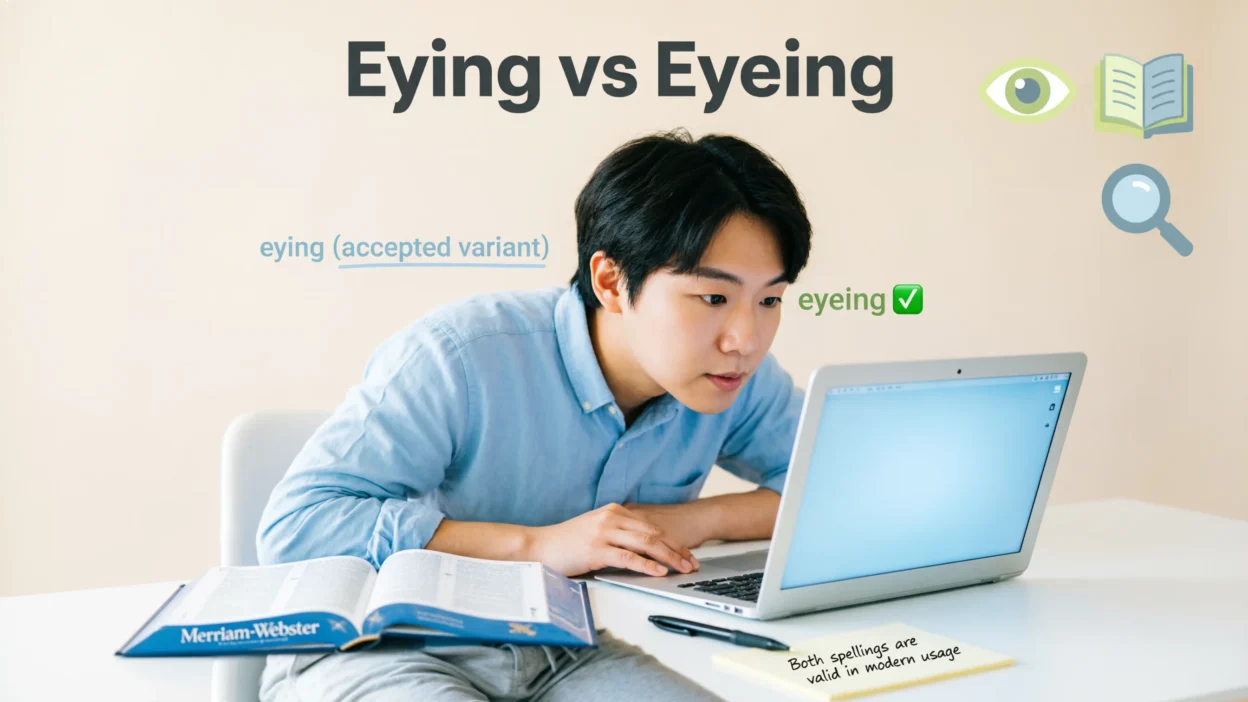
In modern writing, eyeing is generally the preferred and more widely used spelling, while eying is a recognized variant that appears less frequently.
Quick Answer
- Eyeing is the most common and preferred spelling.
- Eying is also correct but less common.
- Both mean looking at something with interest, attention, or intention.
Examples
- She was eyeing the last slice of pizza.
- He kept eyeing the new car in the showroom.
What Does “Eyeing” Mean?
Eyeing is the present participle of the verb eye.
It means:
- looking at something carefully
- watching with interest
- considering something as a possibility
Examples of Eyeing
- She is eyeing a promotion at work.
- The cat was eyeing the bird.
- They are eyeing a new house.
- He kept eyeing the dessert menu.
What Does “Eying” Mean?
Eying has exactly the same meaning as eyeing.
Examples of Eying
- She was eying the prize.
- The investors were eying new opportunities.
Although correct, this spelling appears less often in modern publications.
Eying vs Eyeing: Main Difference
| Word | Status | Usage |
|---|---|---|
| Eyeing | Preferred spelling | Most common form |
| Eying | Accepted variant | Less common form |
Why Are There Two Spellings?
The verb eye ends with the letter e.
When forming the present participle, writers have historically used two approaches:
Method 1
Keep the full word:
- eye → eyeing
Method 2
Drop the final e:
- eye → eying
Both forms became accepted, though eyeing eventually became more popular.
Which Spelling Is More Common?
Today, eyeing is generally preferred in:
- newspapers
- magazines
- books
- online publications
Examples
- eyeing a promotion
- eyeing the competition
- eyeing the market
American vs British English Differences
Both American and British English recognize:
- eyeing
- eying
However, eyeing is more commonly seen in both varieties.
Common Mistakes People Make
Mistake 1: Thinking Eying Is Wrong
It is not wrong; it is simply less common.
Mistake 2: Assuming Both Are Used Equally
Most modern style guides and publishers favor eyeing.
Mistake 3: Confusing Eyeing With Seeing
Eyeing often suggests focused attention or interest, not merely looking.
Examples in Everyday Sentences
Using “Eyeing”
- She is eyeing a new laptop.
- The dog was eyeing my sandwich.
- Investors are eyeing the technology sector.
- He kept eyeing the exit.
Using “Eying”
- She was eying the opportunity.
- They were eying the vacant property.
Both are correct, though eyeing feels more natural to many readers.
Easy Memory Trick
Think of the full word:
- eye
When adding -ing, keep the entire word:
- eye + ing = eyeing
This makes it easier to remember the most common spelling.
Related Words and LSI Keywords
Here are related phrases connected to eying or eyeing:
- eyeing meaning
- eying meaning
- present participle of eye
- English spelling variations
- grammar tips
- looking with interest
- common spelling questions
- eye verb forms
- writing style guide
- English vocabulary
FAQs About Eying or Eyeing
Which spelling is correct: eying or eyeing?
Both are correct, but eyeing is more common.
Is eying a real word?
Yes. It is an accepted variant spelling.
Which spelling should I use?
Most writers and editors prefer eyeing.
What does eyeing mean?
It means looking at something with interest, attention, or intent.
Is eyeing American English?
Yes, but it is also commonly used in British English.
Is eying wrong?
No. It is simply less common.
Which spelling appears more often in publications?
Eyeing is generally the preferred form.
Final Thoughts on Eying vs Eyeing
The difference between eying or eyeing is mainly one of spelling preference rather than meaning. Both forms are correct and mean looking at something carefully or with interest. However, eyeing is the more widely used and preferred spelling in modern English.
If you’re unsure which version to choose, eyeing is usually the safest option because it is the form most readers expect to see.

Born where forests whisper and rain writes stories on glass, Ethan Walker found meaning in silence. He writes not to impress but to express the quiet battles, unseen growth, and the beauty of becoming. His words are simple yet lasting, like echoes the heart refuses to forget.