If you’ve ever paused over gluing vs glueing, you’re not alone. The double-“e” looks tempting—but standard English has a clear winner.
In this simple, human-friendly guide, you’ll learn the correct spelling, why it works, examples, common mistakes, and a quick rule to remember gluing vs glueing forever.
Quick Answer
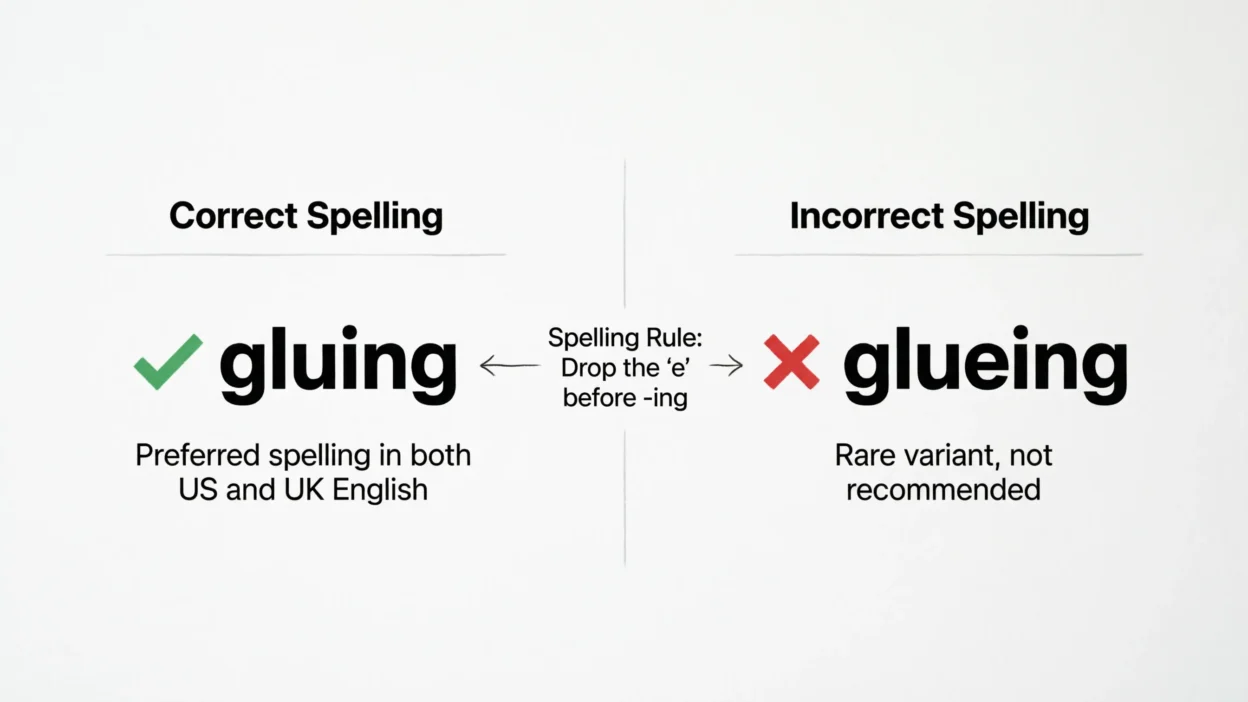
- ✔️ Gluing = correct spelling
- ❌ Glueing = incorrect / non-standard
👉 Always use gluing.
What Does “Gluing” Mean?


5
Gluing is the present participle of glue, meaning to stick things together using adhesive.
Examples
- She is gluing the paper pieces together.
- He is gluing the broken chair.
- They are gluing decorations for the project.
Why Not “Glueing”?
❌ Glueing adds an unnecessary extra “e.”
In English spelling rules:
- When a verb ends in -e, we usually drop the “e” before adding -ing
👉 glue → glu + ing = gluing ✔️
Not: glue + ing = glueing ❌
Easy Spelling Rule
👉 Drop the silent “e” before adding -ing
Examples:
- make → making
- write → writing
- glue → gluing
Gluing vs Glueing: Key Differences
| Feature | Gluing | Glueing |
|---|---|---|
| Spelling | Correct | Incorrect |
| Rule | Drop “e” + add “ing” | Breaks rule |
| Usage | Standard English | Non-standard |
| Recommendation | ✔️ Always use | ❌ Avoid |
Common Mistakes to Avoid
❌ Keeping the Extra “E”
Wrong: She is glueing paper.
✔️ Right: She is gluing paper.
❌ Overthinking the Spelling
Just remember: drop the “e” → add “ing”
❌ Typing Errors
Double-check spelling when writing fast.
Real-Life Examples
- I am gluing photos into my album.
- He is gluing the broken parts together.
- We are gluing decorations for the event.
- She spent hours gluing craft pieces.
American vs British English
There is no difference:
- ✔️ American English: gluing
- ✔️ British English: gluing
👉 “Glueing” is not standard in either.
When to Use “Gluing”
Use “Gluing” When:
- Talking about sticking things together
- Writing present continuous sentences
- Describing crafts, repairs, or projects
👉 Always use gluing, never “glueing.”
FAQs
1. Is “glueing” ever correct?
No, it’s considered incorrect in standard English.
2. Why do we drop the “e”?
Because of the common -e → -ing spelling rule.
3. What is the correct form?
The correct form is gluing.
4. Is this a common mistake?
Yes, very common.
5. Do other words follow this rule?
Yes, like making, writing, driving.
6. Does pronunciation change?
No, pronunciation stays the same.
7. What’s the easiest way to remember?
Drop the “e” before adding “ing.”
Final Summary
The confusion between gluing vs glueing is easy to fix: gluing is correct, and glueing is incorrect. Just follow the simple rule—drop the silent “e” before adding “-ing.”

In a city that never pauses, Madison Blake learned to feel deeply. She turns love into lines and heartbreak into something almost beautiful. Her words reveal what many hide soft truths, loud emotions, and everything in between writing for hearts still learning how to heal.