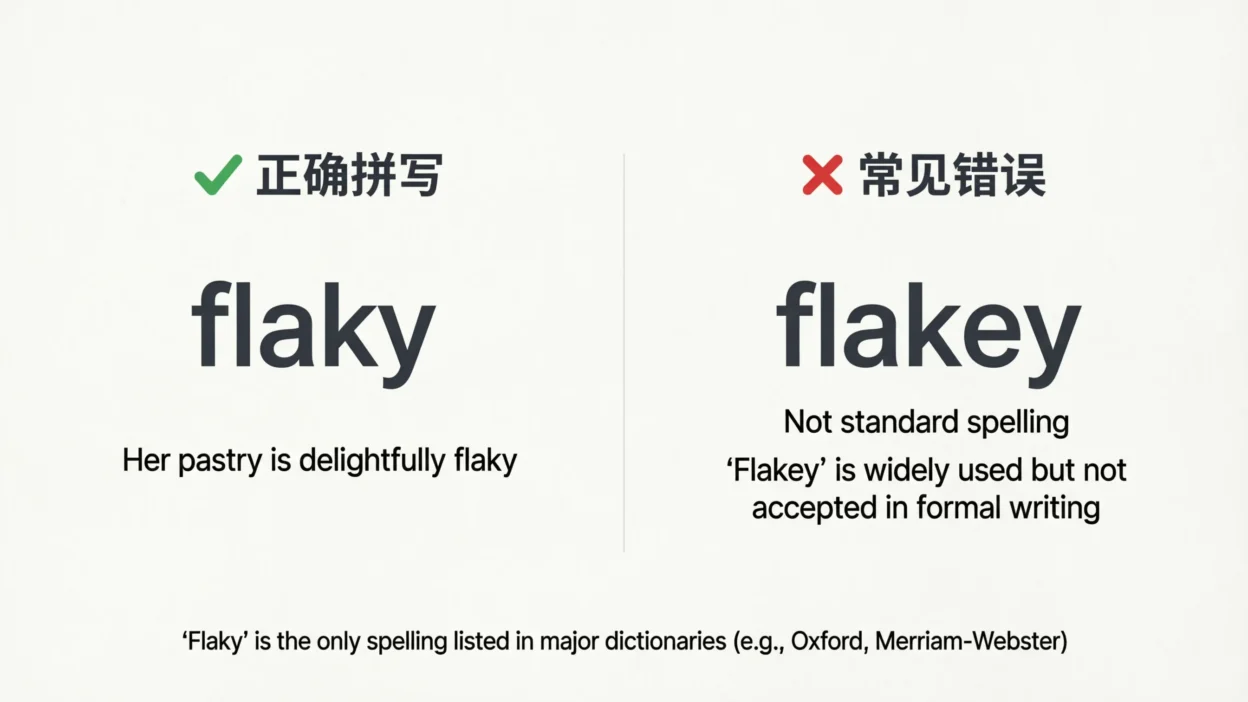
If you’ve ever hesitated between flaky and flakey, you’re not alone. Both spellings appear online—but only one is considered standard in modern English.
In this clear, friendly guide, you’ll learn the difference between flaky vs flakey, when to use each, examples, common mistakes, and a simple rule to remember.
Quick Answer
- ✔️ Flaky = correct and standard spelling
- ⚠️ Flakey = less common variant (generally avoid)
👉 Best choice: Use “flaky” in almost all situations
What Does “Flaky” Mean?


4
Flaky is an adjective with a few common meanings:
1. Crumbly or Layered Texture (Food)
- The croissant is light and flaky.
- This pastry has a flaky crust.
2. Dry or Peeling Skin
- My skin feels flaky in winter.
3. Unreliable or Inconsistent (Informal)
- He’s a bit flaky—he cancels plans often.
What About “Flakey”?


6
Flakey is a less common alternative spelling of “flaky.”
- It appears occasionally in informal writing
- However, it’s not the preferred or standard form
👉 In professional, academic, or SEO writing, always use flaky
Flaky vs Flakey: Key Differences
| Feature | Flaky | Flakey |
|---|---|---|
| Meaning | Crumbly / unreliable | Same meaning |
| Usage | Very common | Rare |
| Preference | Standard spelling | Non-standard variant |
| Recommendation | ✔️ Use this | ⚠️ Avoid if unsure |
Why “Flaky” Is Preferred
Modern English favors simpler, cleaner spellings:
- Words ending in -y are more common than -ey
- “Flaky” follows standard adjective patterns
👉 That’s why flaky is widely accepted and used.
Easy Way to Remember
- Flaky = standard
- Flakey = extra letter (unnecessary)
👉 Trick:
“Keep it simple → flaky”
Common Mistakes to Avoid
❌ Using “Flakey” in Formal Writing
Wrong: The crust is flakey.
✔️ Right: The crust is flaky.
❌ Inconsistent Spelling
Don’t switch between “flaky” and “flakey” in the same text.
❌ Assuming Both Are Equal
While both exist, only flaky is standard.
Real-Life Examples
- The pie has a flaky crust.
- His behavior is a bit flaky.
- My skin becomes flaky in winter.
- She baked perfectly flaky biscuits.
American vs British English
There is no difference:
- ✔️ American English: flaky
- ✔️ British English: flaky
👉 Both prefer flaky, not “flakey.”
When to Use Flaky vs Flakey
Use “Flaky” When:
- Writing professionally
- Describing texture or behavior
- Creating content or blogs
Avoid “Flakey” When:
- Writing formal or academic content
- You want standard English
FAQs
1. Is “flakey” incorrect?
Not completely, but it’s non-standard and less preferred.
2. Which spelling is correct?
Flaky is the correct and standard spelling.
3. Do both mean the same?
Yes, same meaning.
4. Which should I use in exams?
Always use flaky.
5. Is this a common confusion?
Yes, especially in writing.
6. Why is flaky preferred?
It follows modern spelling patterns.
7. What’s the safest option?
Use flaky every time.
Final Summary
Understanding flaky vs flakey is simple: both exist, but flaky is the correct and widely accepted spelling. “Flakey” is rare and should generally be avoided in professional or clear writing.

From restless dreams to relentless pursuit, Noah Carter writes for those who refuse to quit. His verses carry fire, blending discipline with ambition in every line. He believes success begins within, and his words serve as a steady reminder to rise again and again.