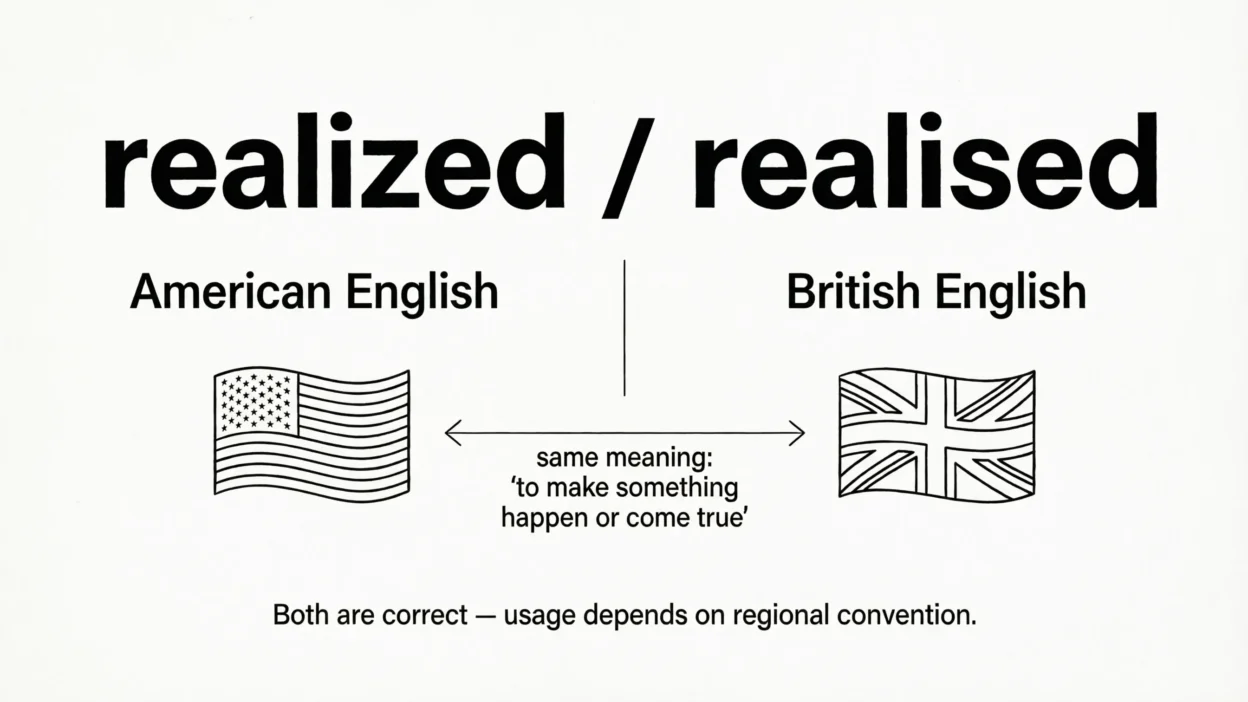
If you’re confused between realized and realised, don’t worry—both spellings are correct. The difference simply depends on whether you’re using American English or British English.
In this simple, human-friendly guide, you’ll learn the difference between realized vs realised, when to use each, examples, common mistakes, and an easy way to remember them.
Quick Answer
- ✔️ Realized = American English
- ✔️ Realised = British English
👉 Same meaning, different regional spelling.
What Does “Realized / Realised” Mean?


6
Both realized and realised mean:
- Understood something clearly
- Became aware of something
- Achieved or fulfilled something
Examples
- I realized/realised my mistake.
- She finally realized/realised the truth.
- They realized/realised their dream.
Realized vs Realised: Key Differences
| Feature | Realized | Realised |
|---|---|---|
| Region | American English | British English |
| Spelling | Uses “z” | Uses “s” |
| Meaning | Same | Same |
| Usage | US and Canada (often) | UK, Australia, etc. |
Why the Spellings Are Different
American and British English often spell words differently:
American English
- Organize
- Realize
- Recognize
British English
- Organise
- Realise
- Recognise
👉 Both systems are correct within their style.
Easy Way to Remember
- Realized = American English (z)
- Realised = British English (s)
👉 Trick:
“Z for the USA, S for the UK style”
Common Mistakes to Avoid
❌ Mixing Styles
Wrong: The article uses both realized and realised together.
✔️ Stay consistent:
- Use one spelling style throughout your writing.
❌ Thinking One Is Incorrect
Both are grammatically correct.
Real-Life Examples
- I suddenly realized the answer. (US)
- I suddenly realised the answer. (UK)
- She realized her potential.
- She realised her potential.
👉 Both versions are correct.
American vs British English
American English
- Prefers realized
British English
- Often prefers realised
👉 However, some British publishers also accept “realize.”
When to Use Realized vs Realised
Use “Realized” When:
- Writing for American audience
- Following US spelling style
Use “Realised” When:
- Writing for British audience
- Following UK spelling conventions
FAQs
1. Is “realised” wrong?
No, it’s correct in British English.
2. Which spelling is more common online?
Realized is slightly more common globally.
3. Do both mean the same thing?
Yes, completely the same meaning.
4. Which should I use in exams?
Use the spelling style required by your school or country.
5. Can British English use “realize”?
Yes, some UK publications prefer “ize” forms.
6. Is this confusion common?
Yes, very common in international writing.
7. What’s the easiest choice?
Use the spelling style that matches your audience.
Final Summary
Understanding realized vs realised is easy: both are correct and mean the same thing. The only difference is regional spelling—realized is American English, while realised is British English.
The key is consistency. Pick one style and use it throughout your writing.