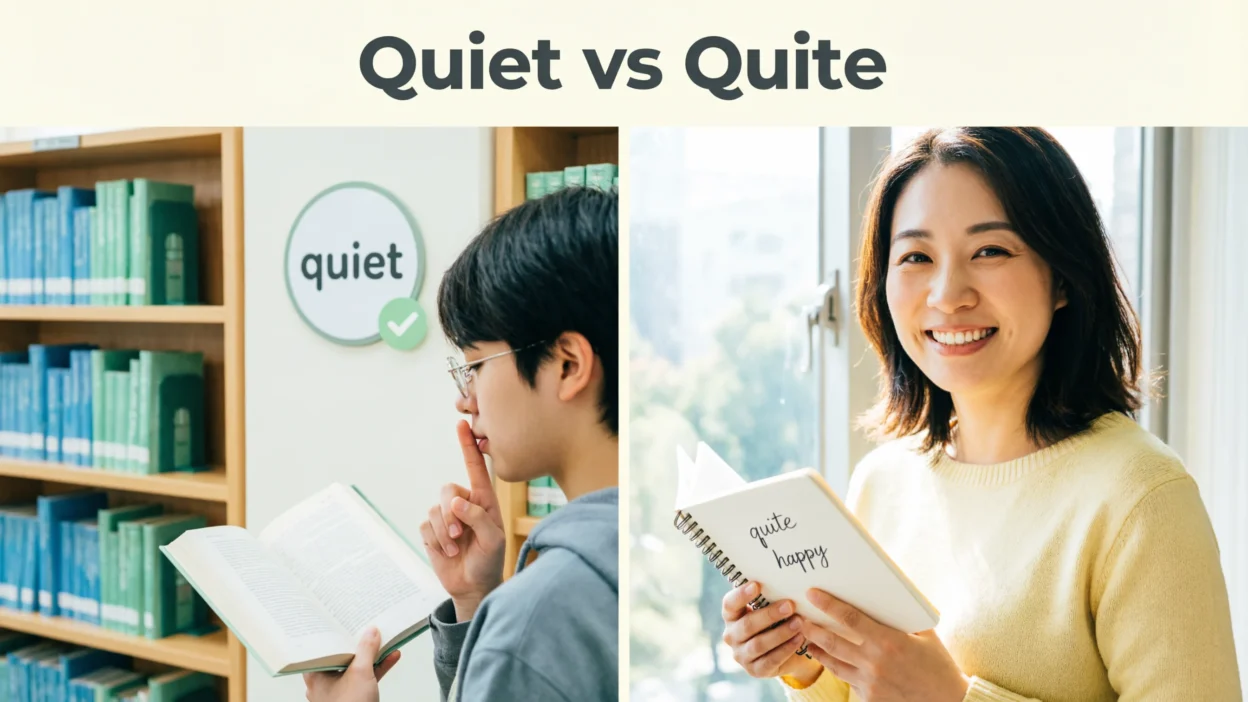
The words quiet and quite look very similar, but they have completely different meanings. Because only two letters switch places, many writers accidentally use one when they mean the other.
Understanding the difference between quiet and quite can help you avoid a common English mistake and make your writing clearer and more professional.
Quick Answer
- Quiet means silent, calm, or making little noise.
- Quite means fairly, completely, or very.
Examples
- Please be quiet during the presentation.
- The movie was quite interesting.
What Does “Quiet” Mean?
Quiet is usually an adjective that describes something with little or no noise.
Meanings of Quiet
- silent
- calm
- peaceful
- not loud
Examples of Quiet
- The library is very quiet.
- Please keep quiet.
- We enjoyed a quiet evening at home.
- The neighborhood is quiet at night.
What Does “Quite” Mean?
Quite is an adverb used to add emphasis.
Depending on context, it can mean:
- fairly
- rather
- completely
- very
Examples of Quite
- The test was quite difficult.
- She is quite talented.
- I’m quite sure about the answer.
- The food was quite good.
Quiet vs Quite: Main Difference
| Word | Part of Speech | Meaning |
|---|---|---|
| Quiet | Adjective/Noun/Verb | Silent or calm |
| Quite | Adverb | Fairly, rather, or completely |
Using “Quiet” in Sentences
Describing Silence
- The classroom became quiet.
Describing Peacefulness
- They live in a quiet village.
As a Command
- Quiet, please!
As a Verb
- The crowd began to quiet down.
Using “Quite” in Sentences
Showing Degree
- She is quite intelligent.
Expressing Certainty
- I’m quite certain.
Adding Emphasis
- The concert was quite amazing.
Describing Amount
- The project took quite a while.
Common Mistakes People Make
Mistake 1: Using Quiet Instead of Quite
Incorrect:
- I am quiet happy today.
Correct:
- I am quite happy today.
Mistake 2: Using Quite Instead of Quiet
Incorrect:
- Please be quite during the exam.
Correct:
- Please be quiet during the exam.
Mistake 3: Relying Only on Sound
The words look similar but have different meanings and grammatical roles.
American vs British English Differences
There is no major spelling difference.
Both Use:
- quiet
- quite
However, British English often uses quite to mean “fairly” more frequently than American English.
British Example
- The meal was quite nice.
American Example
- The meal was pretty good.
Easy Memory Trick
Quiet = Silence
Notice that quiet contains the word:
- QUIET → no noise
Think:
- “Keep quiet.”
Quite = Degree
Think:
- “Quite” = “very” or “fairly”
Example:
- quite good
- quite interesting
- quite certain
Examples in Everyday Sentences
Correct Use of Quiet
- The baby is finally quiet.
- We found a quiet place to study.
- Please remain quiet.
Correct Use of Quite
- The weather is quite pleasant.
- She was quite surprised.
- I’m quite confident.
Related Words and LSI Keywords
Here are related phrases connected to quiet or quite:
- quiet meaning
- quite meaning
- commonly confused words
- English grammar tips
- spelling mistakes
- homophone-like words
- quiet vs quite examples
- English vocabulary
- adjective vs adverb
- writing accuracy
FAQs About Quiet or Quite
Which is correct: quiet or quite?
Both are correct, but they have different meanings.
What does quiet mean?
It means silent, calm, or not loud.
What does quite mean?
It means fairly, rather, very, or completely.
Is quiet an adjective?
Yes, although it can also be used as a noun or verb.
Is quite an adverb?
Yes. It modifies adjectives, verbs, and other adverbs.
How do I remember the difference?
Think:
- quiet = silence
- quite = degree or emphasis
Can quiet and quite be used interchangeably?
No. They have completely different meanings.
Final Thoughts on Quiet vs Quite
The difference between quiet or quite is simple once you know their meanings. Quiet relates to silence, calmness, and the absence of noise, while quite is an adverb used to add emphasis or indicate degree.
Since these words are frequently confused in writing, taking a moment to check which one fits your sentence can greatly improve clarity. Remember that quiet describes a state, while quite modifies another word.

Born where forests whisper and rain writes stories on glass, Ethan Walker found meaning in silence. He writes not to impress but to express the quiet battles, unseen growth, and the beauty of becoming. His words are simple yet lasting, like echoes the heart refuses to forget.