The words wont and won’t may look nearly identical, but they have completely different meanings and grammar functions. The confusion usually happens because the apostrophe in won’t is small and easy to overlook in writing.
In modern English, won’t is extremely common, while wont is much rarer and used mostly in formal or literary contexts. Understanding the difference can help you avoid grammar mistakes and improve your writing clarity.
This guide explains the meanings, examples, pronunciation, grammar rules, common mistakes, and American vs British English usage for wont and won’t.
Quick Answer
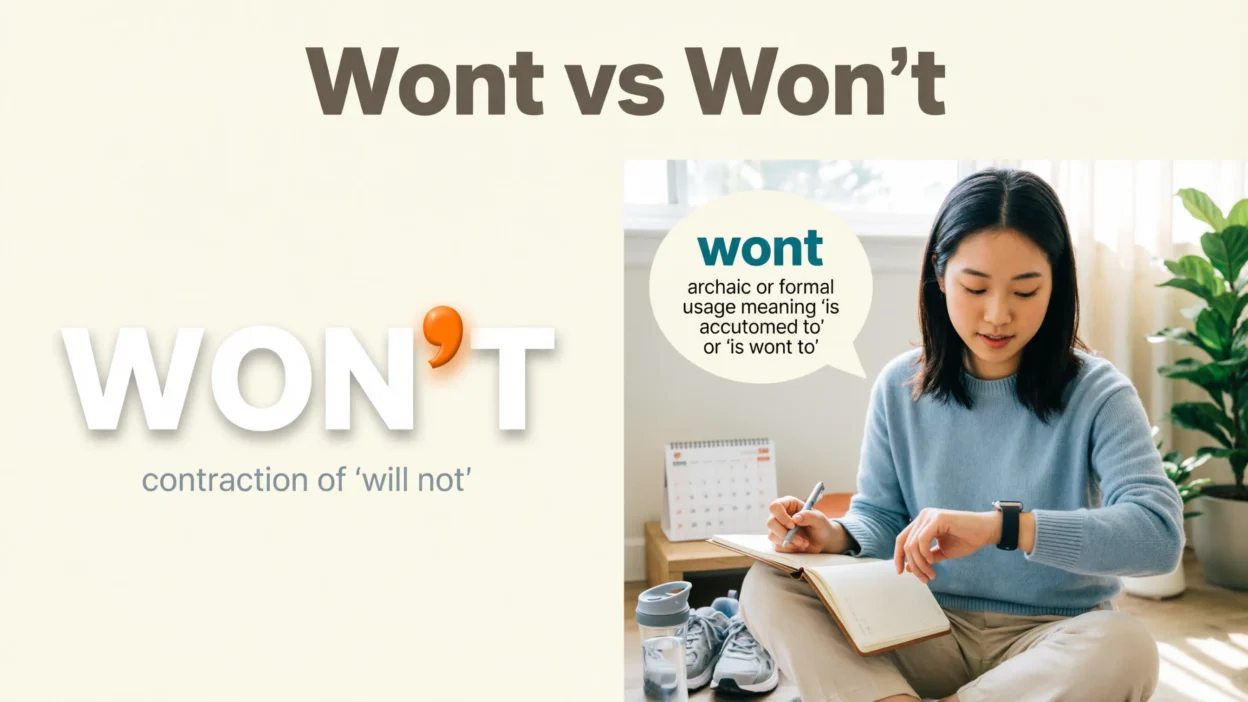
- Won’t is the contraction of will not.
- Wont means accustomed or used to something.
Simple Difference
- Won’t = refusal or future negative
- Wont = habit or customary behavior
What Does “Won’t” Mean?
Won’t is the shortened contraction of:
- will not
It is one of the most common contractions in English and is used to express:
- refusal
- negative future actions
- unwillingness
Examples of Won’t
- I won’t forget your birthday.
- She won’t answer the phone.
- They won’t be coming tonight.
- He won’t listen to advice.
- The car won’t start.
Common Uses of Won’t
Future Negative Statements
- We won’t arrive before noon.
Refusal
- The child won’t eat vegetables.
Predictions
- This problem won’t disappear overnight.
What Does “Wont” Mean?
Wont is a formal adjective or noun meaning:
- accustomed
- habitual
- used to doing something
It is much less common in everyday English.
Examples of Wont
- He was wont to wake early.
- She is wont to stay quiet in meetings.
- As was his wont, he arrived late.
Wont as a Formal Expression
The phrase:
- “as is his/her wont”
means: - as someone usually does
- according to someone’s habit
Example
- As was her wont, she brought homemade cookies.
Wont vs Won’t: Main Difference
| Word | Meaning | Usage |
|---|---|---|
| Wont | Accustomed or habitual | Formal/literary |
| Won’t | Will not | Everyday English |
Pronunciation Difference
Won’t
Pronounced:
- wohnt
Wont
Pronounced:
- wuhnt or wont
The pronunciation can vary slightly depending on accent and formality.
Why “Won’t” Is More Common
In everyday conversation and writing, people almost always mean won’t rather than wont.
Common Examples
- I won’t go.
- He won’t help.
- They won’t agree.
Meanwhile, wont mostly appears in:
- literature
- formal essays
- historical writing
Common Mistakes People Make
Mistake 1: Forgetting the Apostrophe
Incorrect:
- I wont do it.
Correct:
- I won’t do it.
Without the apostrophe, the meaning changes completely.
Mistake 2: Assuming Wont Is a Spelling Error
Wont is actually a real English word, though it is rare.
Mistake 3: Using Wont Casually
In modern casual English, people usually say:
- used to
instead of: - wont
American vs British English Differences
There is no major spelling difference between American and British English here.
Both Use:
- won’t for “will not”
- wont for “accustomed”
However:
- British literature may use wont slightly more often in formal writing.
Grammar Rule Made Simple
Use “Won’t” When:
You mean:
- will not
Examples:
- She won’t attend the meeting.
- I won’t give up.
Use “Wont” When:
You mean:
- accustomed or habitually doing something
Examples:
- He is wont to exaggerate.
- As was her wont, she stayed silent.
Examples in Everyday Sentences
Sentences With “Won’t”
- The baby won’t sleep.
- We won’t be late.
- My computer won’t turn on.
Sentences With “Wont”
- He was wont to complain about the weather.
- The professor was wont to lecture for hours.
- As is their wont, the team celebrated loudly.
Easy Memory Trick
Here’s a quick trick:
- Won’t has an apostrophe because it combines two words:
- will + not
- Wont has no apostrophe because it’s a separate vocabulary word.
If you mean “will not,” always use the apostrophe.
Related Words and LSI Keywords
Here are related phrases connected to wont or won’t:
- won’t meaning
- wont definition
- grammar mistakes
- apostrophe usage
- contractions in English
- will not contraction
- formal English vocabulary
- commonly confused words
- English grammar rules
- literary expressions
FAQs About Wont or Won’t
Is wont a real word?
Yes. Wont means accustomed or habitual.
Which is more common: wont or won’t?
Won’t is far more common in modern English.
What does “as is his wont” mean?
It means “as he usually does.”
Is wont old-fashioned?
Yes, it sounds formal or literary in modern English.
Why does won’t have an apostrophe?
Because it is a contraction of will not.
Can I write “I wont do it”?
Not if you mean will not. The correct form is “I won’t do it.”
Do British and American English differ here?
Not significantly, though literary British English may use wont slightly more often.
Final Thoughts on Wont vs Won’t
The difference between wont or won’t mainly comes down to grammar and punctuation. Won’t is the common contraction of will not and appears constantly in everyday English. Wont, on the other hand, is a rare formal word meaning accustomed or habitual.
Because the apostrophe changes the meaning completely, it’s important to pay close attention when writing. Understanding this small distinction can make your English clearer, more professional, and grammatically accurate.

Born where forests whisper and rain writes stories on glass, Ethan Walker found meaning in silence. He writes not to impress but to express the quiet battles, unseen growth, and the beauty of becoming. His words are simple yet lasting, like echoes the heart refuses to forget.