The confusion between curtesy and courtesy is a common English spelling mistake because the two words sound somewhat similar when spoken quickly. However, in modern English, they have completely different meanings and usage patterns.
Most of the time, courtesy is the correct word people intend to use. The spelling curtesy is a rare legal term that is almost never used in everyday conversation or writing.
This guide explains the meanings, pronunciation, examples, grammar rules, common mistakes, and American vs British English differences for curtesy and courtesy.
Quick Answer
- Courtesy is the common and correct everyday word.
- Curtesy is an old legal term rarely used today.
Simple Difference
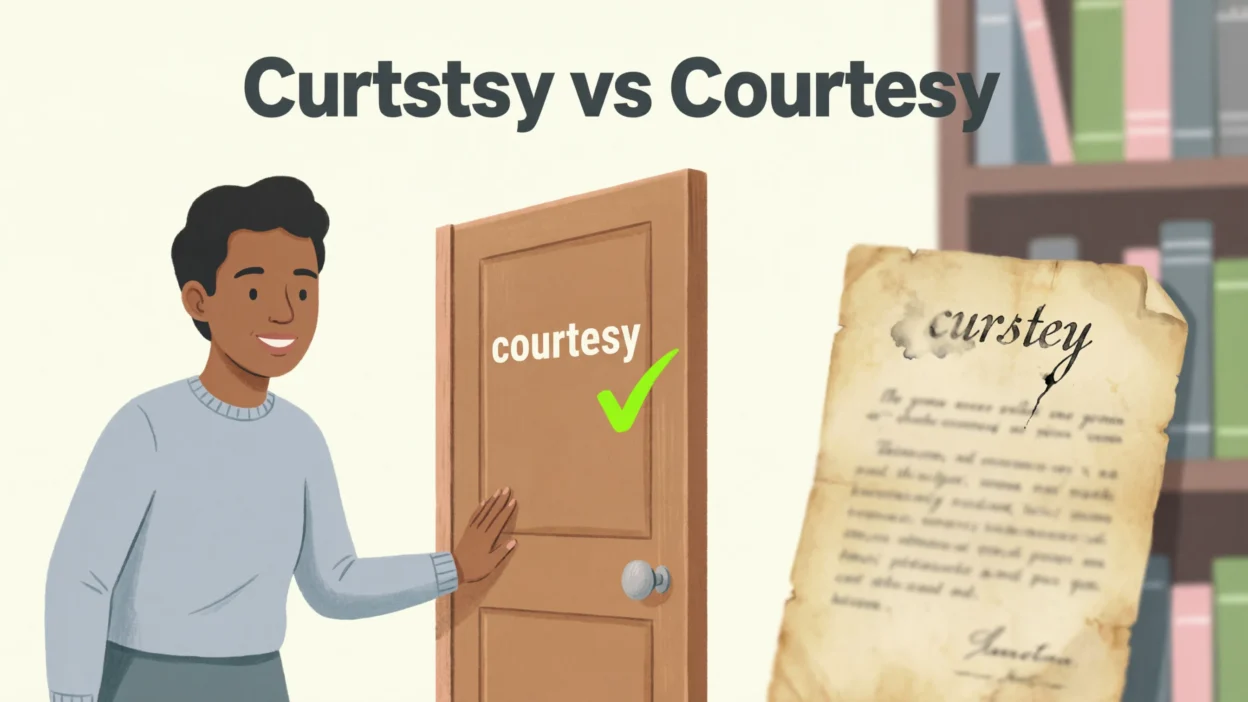
- Courtesy = politeness or respectful behavior
- Curtesy = historical legal right of a widower
What Does “Courtesy” Mean?
The word courtesy refers to:
- politeness
- respectful behavior
- good manners
- thoughtful actions
It is commonly used in both spoken and written English.
Courtesy as a Noun
Examples
- She treated everyone with courtesy.
- Common courtesy is important in public places.
- Thank you for your courtesy and kindness.
- The staff showed great courtesy to visitors.
Courtesy in Common Expressions
Courtesy Call
A polite or formal visit.
Courtesy Copy
A copy of a document shared for information.
Courtesy of
Meaning:
- provided by
- thanks to
Example:
- Photos courtesy of the local museum.
What Does “Curtesy” Mean?
Curtesy is a rare historical legal term from old English law.
It refers to:
- a widower’s legal right to his deceased wife’s property under certain conditions.
This term appears mainly in:
- historical legal documents
- law history discussions
- older texts
Historical Example
- The husband claimed curtesy rights to the estate.
Most native speakers never use this word in normal conversation.
Curtesy vs Courtesy: Main Difference
| Word | Meaning | Modern Usage |
|---|---|---|
| Courtesy | Politeness and respect | Very common |
| Curtesy | Historical legal term | Extremely rare |
Pronunciation Difference
Courtesy
Pronounced:
- KUR-tuh-see
Curtesy
Pronounced:
- very similarly to courtesy
Because the pronunciation is close, spelling confusion is common.
Why “Courtesy” Is Usually Correct
In everyday English, people almost always mean:
- courtesy
Common Situations
- showing politeness
- respectful behavior
- professional communication
- customer service
- manners and etiquette
Meanwhile, curtesy is mostly limited to:
- legal history
- old property laws
Common Mistakes People Make
Mistake 1: Spelling Courtesy as Curtesy
Incorrect:
- Thank you for your curtesy.
Correct:
- Thank you for your courtesy.
Mistake 2: Assuming Curtesy Is a Modern Variant
It is not simply an alternative spelling.
Mistake 3: Mixing Formal Vocabulary
Many people accidentally type curtesy because of pronunciation confusion.
American vs British English Differences
There is no major spelling difference between American and British English for these words.
Both Use:
- courtesy
Both Rarely Use:
- curtesy
Examples in Everyday Sentences
Correct Sentences With “Courtesy”
- He opened the door as a courtesy.
- Courtesy matters in customer service.
- The hotel staff treated guests with courtesy.
- Please show courtesy to others.
Historical Sentences With “Curtesy”
- Medieval laws included curtesy rights for widowers.
Easy Memory Trick
Here’s a simple way to remember:
- Courtesy contains:
- “court”
- Think of polite royal court manners.
Meanwhile:
- curtesy belongs mostly to old legal courts.
If you mean politeness, always choose:
- courtesy
Related Words and LSI Keywords
Here are related phrases connected to curtesy or courtesy:
- courtesy meaning
- courtesy spelling
- curtesy definition
- common spelling mistakes
- polite behavior
- English grammar tips
- respectful language
- etiquette vocabulary
- commonly confused words
- legal historical terms
FAQs About Curtesy or Courtesy
Which spelling is correct: curtesy or courtesy?
For everyday English, courtesy is correct.
Is curtesy a real word?
Yes, but it is a rare historical legal term.
What does courtesy mean?
It means politeness, respect, or good manners.
Why do people confuse curtesy and courtesy?
Because they sound very similar when spoken.
Is curtesy still used today?
Very rarely, mostly in historical legal contexts.
Do British and American English differ here?
No. Both strongly prefer courtesy in normal usage.
What does “courtesy of” mean?
It means something was provided by or thanks to someone.
Final Thoughts on Curtesy vs Courtesy
The difference between curtesy or courtesy mainly comes down to modern versus historical usage. Courtesy is the standard modern English word used to describe politeness, respectful behavior, and good manners. In contrast, curtesy is a rare legal term that most people will never encounter outside historical law discussions.