If you’ve ever been confused between begun and began, you’re not alone. These two forms come from the verb begin, but they’re used in different grammatical situations.
In this simple, human-friendly guide, you’ll learn the clear difference between begun vs began, when to use each, real examples, common mistakes, and an easy trick to remember them forever.
Quick Answer
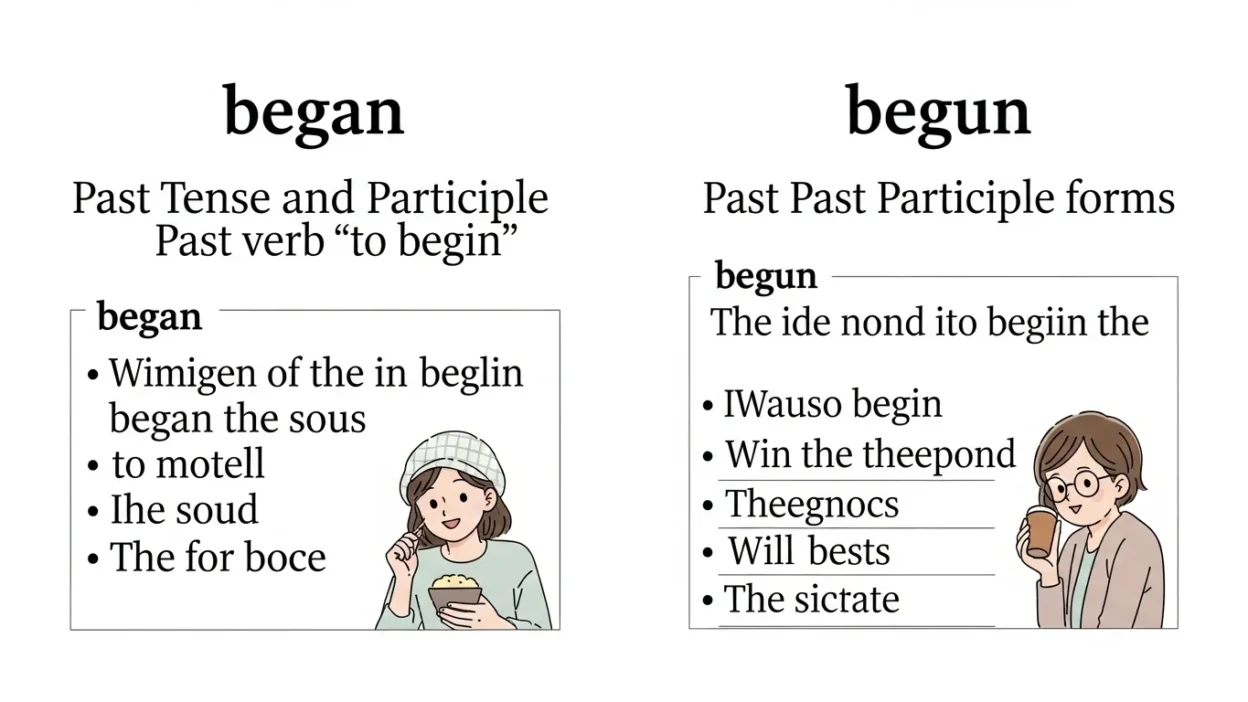
- Began = past tense (something started in the past)
- Begun = past participle (used with has, have, had)
👉 Example:
- The class began at 9 AM.
- The class has begun already.
What Does “Began” Mean?


5
Began is the simple past tense of begin. It describes something that started and happened in the past.
When to Use “Began”
- With past time words (yesterday, last night, earlier)
- When no helping verb is used
Examples
- The movie began late.
- She began her journey last year.
- The meeting began at noon.
What Does “Begun” Mean?


5
Begun is the past participle of begin. It is always used with helping verbs like has, have, or had.
When to Use “Begun”
- With has/have/had
- For actions connected to the present or completed in the past
Examples
- The movie has begun already.
- They have begun the project.
- She had begun working before I arrived.
Began vs Begun: Key Differences
| Feature | Began | Begun |
|---|---|---|
| Tense | Past tense | Past participle |
| Usage | Simple past | With has/have/had |
| Example | It began yesterday | It has begun |
| Helper Verb | Not used | Required |
Easy Way to Remember
- Began = no helper verb
- Begun = needs helper (has/have/had)
👉 Trick:
“If there’s a helping verb, use begun.”
Common Mistakes to Avoid
❌ Using “Begun” Without Helper
Wrong: The class begun at 9.
✔️ Right: The class began at 9.
❌ Using “Began” with Has/Have
Wrong: The class has began.
✔️ Right: The class has begun.
❌ Mixing Tenses
Always match the structure correctly.
Real-Life Examples
- The event began on time.
- The event has begun already.
- She began studying last night.
- She has begun preparing for exams.
American vs British English
There is no difference between American and British English:
- Both use began (past)
- Both use begun (past participle)
When to Use Began vs Begun
Use “Began” When:
- Talking about a past action
- No helping verb is present
Use “Begun” When:
- Using has, have, or had
- Talking about completed or ongoing actions
FAQs
1. Is “begun” past tense?
No, begun is a past participle.
2. Which is correct: “has began” or “has begun”?
Correct: has begun.
3. Can I say “it begun yesterday”?
No, correct form is: it began yesterday.
4. What is the past tense of begin?
The past tense is began.
5. What is the past participle of begin?
The past participle is begun.
6. Are begun and began interchangeable?
No, they are used in different grammatical structures.
7. What’s the easiest way to remember?
- No helper → began
- With helper → begun
Final Summary
Understanding begun vs began is simple when you focus on tense. Began is used for past actions without a helping verb, while begun is used with has, have, or had.
Using the correct form improves your grammar and makes your writing sound natural and professional.

Born where forests whisper and rain writes stories on glass, Ethan Walker found meaning in silence. He writes not to impress but to express the quiet battles, unseen growth, and the beauty of becoming. His words are simple yet lasting, like echoes the heart refuses to forget.