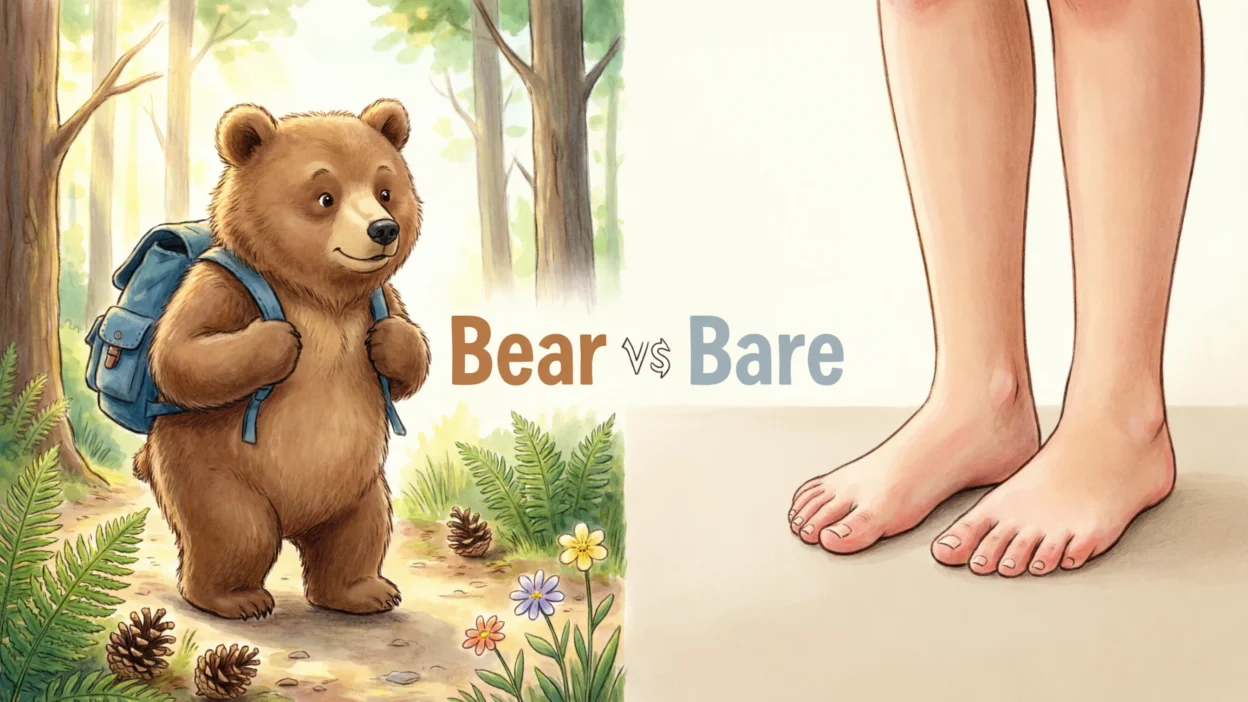
The words bear and bare are classic English homophones. They sound exactly alike but have completely different meanings and spellings. Because of this, many writers accidentally mix them up in emails, essays, social media posts, and everyday conversations.
Learning the difference between bear and bare is easier than it seems. Once you understand their meanings and see them used in real sentences, you’ll know exactly which word fits your context.
Quick Answer
- Bear usually relates to carrying, enduring, tolerating, or the animal.
- Bare means uncovered, empty, exposed, or plain.
Simple Memory Trick
- Bear = carry or tolerate
- Bare = naked or uncovered
What Does “Bear” Mean?
The word bear has several meanings in English. It can be used as both a noun and a verb.
Bear as a Noun
A bear is a large furry animal.
Examples
- We saw a brown bear in the forest.
- Polar bears live in cold regions.
- The bear climbed the tree.
Bear as a Verb
As a verb, bear means:
- to carry
- to support
- to tolerate
- to endure
Examples
- I cannot bear the heat today.
- She bears great responsibility at work.
- The bridge can bear heavy weight.
- He could barely bear the pain.
Common Expressions With “Bear”
Bear in mind
Meaning: remember something
Example:
- Bear in mind that traffic may be heavy.
Bear with me
Meaning: be patient
Example:
- Please bear with me while I check the details.
Grin and bear it
Meaning: tolerate something unpleasant
Example:
- Sometimes you just have to grin and bear it.
What Does “Bare” Mean?
The word bare usually means uncovered, exposed, empty, or plain. It is commonly used as an adjective, though it can also act as a verb.
Bare as an Adjective
Examples
- He walked on the bare floor.
- The tree was bare in winter.
- She had bare feet.
- The walls were completely bare.
Bare as a Verb
As a verb, bare means to reveal or uncover something.
Examples
- He bared his teeth angrily.
- She bared her emotions during the interview.
- The dog bared its fangs.
Bear vs Bare: Main Difference
| Word | Meaning | Example |
|---|---|---|
| Bear | Carry, tolerate, or the animal | I can’t bear the noise. |
| Bare | Uncovered or exposed | She walked with bare feet. |
Common Mistakes People Make
Mistake 1: “Bare with me”
Incorrect:
- Bare with me for a moment.
Correct:
- Bear with me for a moment.
Why? Because bear means tolerate or be patient.
Mistake 2: Using “bear” for uncovered things
Incorrect:
- He had bear hands.
Correct:
- He had bare hands.
Why? Because bare means uncovered.
American vs British English Differences
There are no spelling differences between American and British English for bear and bare. Both varieties use the same spellings and meanings.
However, some expressions may appear more frequently in certain regions. For example:
- “Bear with me” is extremely common in both American and British English.
- “Bare minimum” is also widely used in both forms of English.
Easy Memory Tricks
Bear = Big Animal or Burden
Think of a strong bear carrying weight.
Bare = Bare Skin
Think of something uncovered or exposed.
Synonyms for Bear
Depending on context:
- tolerate
- endure
- carry
- support
- withstand
Synonyms for Bare
Depending on context:
- exposed
- uncovered
- empty
- plain
- reveal
FAQs About Bear or Bare
Is it “bear with me” or “bare with me”?
The correct phrase is bear with me because bear means tolerate or be patient.
What does “bare minimum” mean?
It means the smallest possible amount required.
Can bear and bare be interchangeable?
No. Even though they sound alike, their meanings are completely different.
What is a bare room?
A bare room is empty or lacking decoration.
What does “I can’t bear it” mean?
It means “I can’t tolerate it.”
Is bare only an adjective?
No. It can also be a verb meaning to reveal or uncover.
Final Thoughts on Bear vs Bare
The difference between bear and bare becomes simple once you connect each word to its core meaning. Bear relates to carrying, enduring, or the animal itself, while bare refers to something uncovered or exposed.

Born where forests whisper and rain writes stories on glass, Ethan Walker found meaning in silence. He writes not to impress but to express the quiet battles, unseen growth, and the beauty of becoming. His words are simple yet lasting, like echoes the heart refuses to forget.