
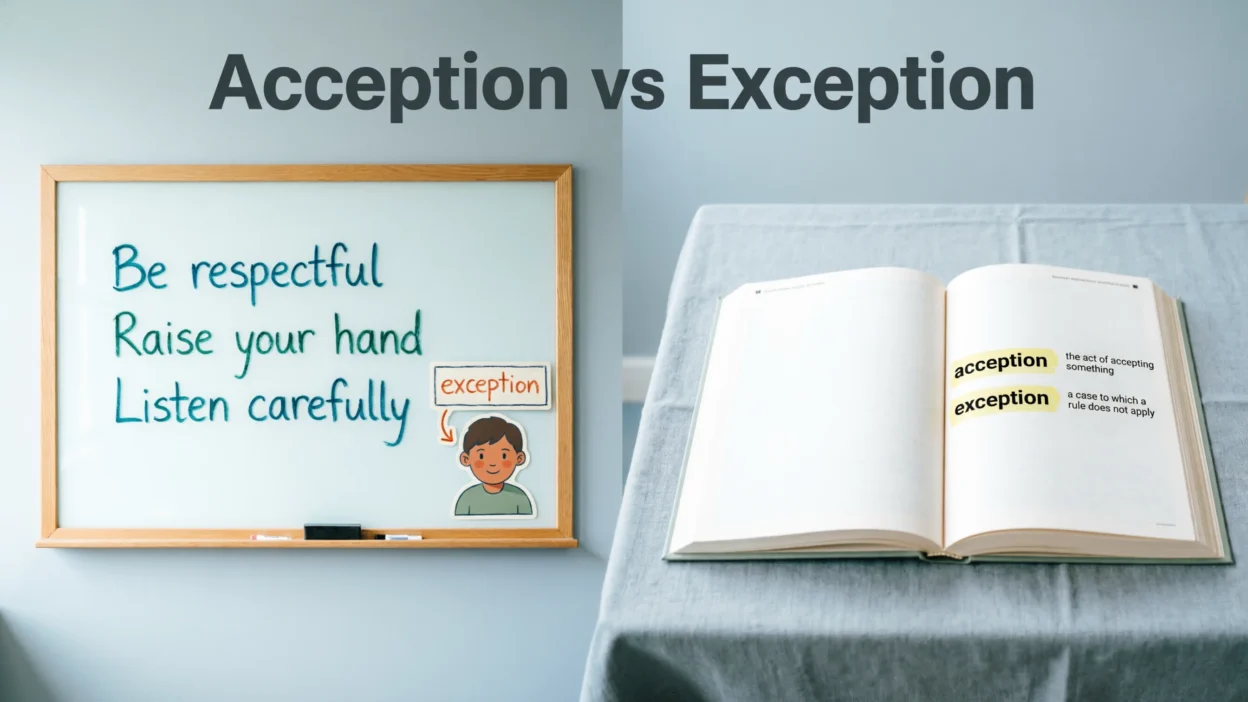
The words acception and exception may look similar, but they are not interchangeable. In fact, one of them is extremely common in modern English, while the other is rare and mostly used in specialized or historical contexts. Because of their similar spelling and pronunciation, many writers accidentally confuse them.
If you’ve ever wondered whether to use acception or exception, this guide will help you understand the meanings, examples, grammar usage, common mistakes, and differences in everyday English. By the end, you’ll know exactly which word fits your sentence correctly.
Quick Answer
- Exception is the common and correct word in everyday English.
- Acception is a rare formal word meaning a specific accepted meaning of a term.
Simple Difference
- Exception = something excluded from a rule
- Acception = an accepted meaning or interpretation of a word
What Does “Exception” Mean?
The word exception refers to something or someone that does not follow a general rule, pattern, or statement. It is one of the most commonly used nouns in English.
Examples of Exception
- Everyone passed the exam with one exception.
- This restaurant is usually excellent, but today was an exception.
- There are no exceptions to the rule.
- She likes all fruits except bananas, which are the exception.
- His behavior was an exception to the norm.
Common Uses of Exception
In Rules and Policies
- No exceptions allowed.
- Late submissions will not be accepted without exception.
In Everyday Conversation
- She never eats fast food, but vacations are an exception.
In Grammar and Logic
- An exception breaks the expected pattern.
What Does “Acception” Mean?
Acception is a rare English noun that refers to the accepted meaning or interpretation of a word or phrase. It is mostly found in linguistics, philosophy, theology, or older academic writing.
Examples of Acception
- The dictionary listed several acceptions of the word.
- In its modern acception, the term has changed meaning.
- Scholars debated the original acception of the phrase.
Why Acception Is Rare
Most native English speakers rarely use acception in everyday speech or writing. Instead, they commonly use:
- meaning
- definition
- interpretation
- sense
For example, instead of saying:
- “the acception of the word”
People usually say:
- “the meaning of the word”
Acception vs Exception: Main Difference
| Word | Meaning | Common Usage |
|---|---|---|
| Acception | Accepted meaning of a term | Rare, academic |
| Exception | Something excluded from a rule | Very common |
Pronunciation Difference
Although similar, the pronunciation is slightly different.
Acception
Pronounced:
- ak-SEP-shən
Exception
Pronounced:
- ik-SEP-shən
The beginning sound changes the meaning entirely.
Common Mistakes People Make
Mistake 1: Using Acception Instead of Exception
Incorrect:
- There was one acception to the rule.
Correct:
- There was one exception to the rule.
Why? Because exception is used for exclusions from rules.
Mistake 2: Assuming Acception Is a Misspelling
Acception is actually a real English word, but it is uncommon and specialized.
Mistake 3: Overusing Acception
In most cases, words like meaning or definition sound much more natural.
American vs British English Differences
There is no major spelling difference between American and British English for these words.
Exception
- Common in both American and British English.
Acception
- Rare in both varieties.
- Mostly seen in formal academic texts.
British and American writers both strongly prefer simpler alternatives like:
- meaning
- definition
- interpretation
Which Word Should You Use?
Use “Exception” When:
You mean something excluded from a rule or pattern.
Examples:
- No exceptions will be made.
- He is the exception to the rule.
Use “Acception” When:
You are discussing the accepted meaning of a word in highly formal or academic contexts.
Examples:
- The philosophical acception of the term evolved over time.
Easy Memory Trick
Here’s a simple way to remember:
- Exception = excluded
- Acception = accepted meaning
Notice how:
- Exception starts with “ex,” which can remind you of “excluded.”
- Acception relates to “accept.”
Synonyms for Exception
Depending on context:
- exclusion
- anomaly
- irregularity
- deviation
- special case
Synonyms for Acception
Depending on context:
- meaning
- definition
- interpretation
- sense
- understanding
Related LSI Keywords
Here are related phrases often searched with acception or exception:
- exception meaning
- acception definition
- exception vs exemption
- grammar mistakes
- commonly confused words
- English vocabulary tips
- accepted meaning
- rule exception examples
- word interpretation
- academic English vocabulary
FAQs About Acception or Exception
Is acception a real word?
Yes, acception is a real English word, though it is rare.
Which word is more common?
Exception is far more common in modern English.
Can I use acception in daily conversation?
You can, but most native speakers prefer simpler words like meaning or definition.
What does “exception to the rule” mean?
It refers to something that does not follow the normal pattern.
Is acception a spelling mistake for exception?
No, but many people mistakenly use it when they actually mean exception.
Which word should students use more often?
Students will usually need exception, not acception.
Is acception used in dictionaries?
Yes, though it is marked as rare or specialized in many dictionaries.
Final Thoughts on Acception vs Exception
The difference between acception and exception is important because the two words serve completely different purposes. Exception is a common everyday word used for exclusions from rules or patterns, while acception is a rare academic term referring to the accepted meaning of a word.
For most writing situations, especially emails, essays, and conversations, you will almost always need exception. Understanding this distinction helps you avoid a common vocabulary mistake and makes your English sound clearer and more professional.

From restless dreams to relentless pursuit, Noah Carter writes for those who refuse to quit. His verses carry fire, blending discipline with ambition in every line. He believes success begins within, and his words serve as a steady reminder to rise again and again.