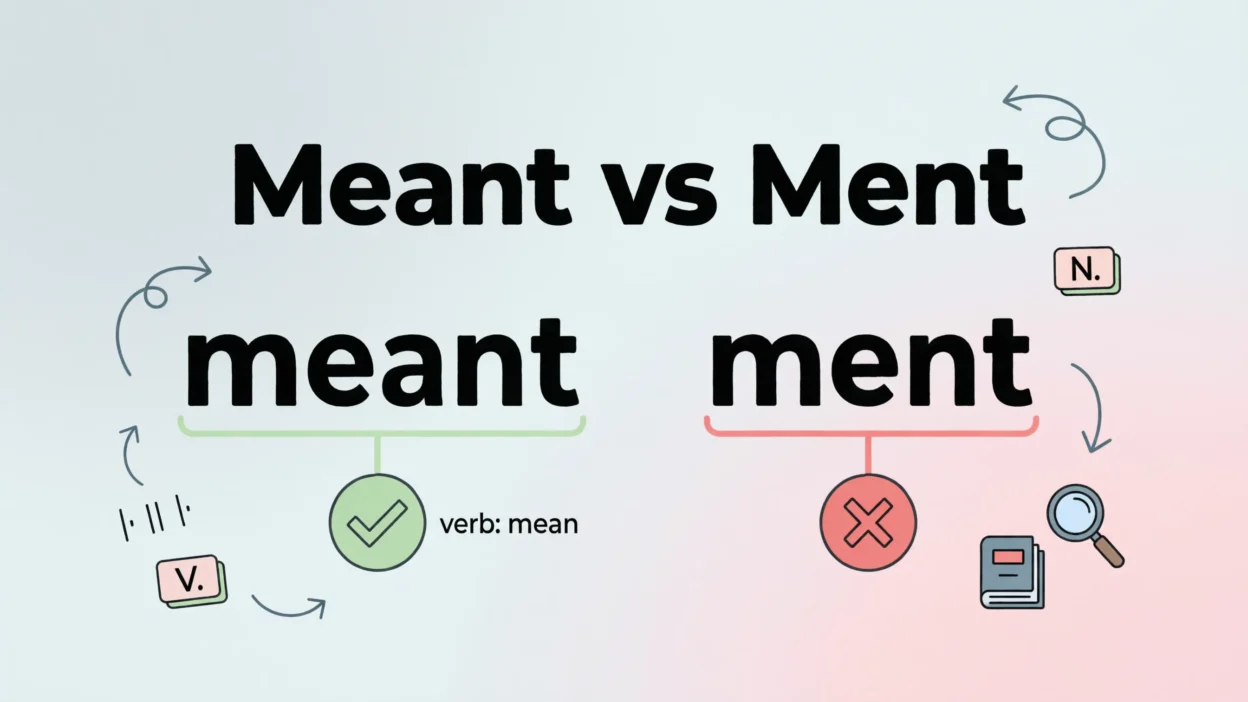
The confusion between meant and ment is a common English spelling mistake. Because the word meant is often pronounced quickly in everyday speech, some people mistakenly leave out the letter a and write ment instead.
In standard English, meant is the correct spelling, while ment is not a standalone English word in this context. Understanding the difference will help you avoid a very common writing error.
Quick Answer
- Meant is the correct spelling.
- Ment is incorrect when used as the past tense of mean.
Correct Examples
- I meant to call you yesterday.
- What did you mean?
- She meant no harm.
What Does “Meant” Mean?
Meant is the past tense and past participle of the verb mean.
It can mean:
- intended
- signified
- referred to
- had a particular purpose
Examples of Meant
- I meant every word I said.
- She meant to arrive earlier.
- What he said meant a lot to me.
- The gift meant everything to her.
Why “Ment” Is Incorrect
The spelling ment is a common typo or misspelling of meant.
Correct Verb Forms
| Base Form | Past Tense | Past Participle |
|---|---|---|
| mean | meant | meant |
Examples
- I mean what I say.
- I meant what I said.
- I have meant to ask you something.
There is no verb form spelled ment.
Meant vs Ment: Main Difference
| Word | Status | Meaning |
|---|---|---|
| Meant | Correct | Past tense of mean |
| Ment | Incorrect | Misspelling |
Common Uses of “Meant”
Showing Intention
- I meant to finish the project.
Expressing Importance
- Your support meant a lot.
Explaining Meaning
- What did you mean by that?
Describing Purpose
- This tool was meant for beginners.
Common Expressions With Meant
Meant To Be
Meaning:
- destined or intended
Example:
- We were meant to be friends.
Didn’t Mean To
Meaning:
- accidental action
Example:
- I didn’t mean to upset you.
Well-Meant
Meaning:
- done with good intentions
Example:
- It was a well-meant suggestion.
Common Mistakes People Make
Mistake 1: Writing “Ment”
Incorrect:
- I ment to send the email.
Correct:
- I meant to send the email.
Mistake 2: Confusing Pronunciation With Spelling
The pronunciation may sound like ment, but the correct spelling includes the letter a.
Mistake 3: Forgetting the Verb Form
Remember:
- mean → meant
Just as:
- keep → kept
- sleep → slept
American vs British English Differences
There is no spelling difference between American and British English.
Both Use:
- meant
Both Reject:
- ment
Examples in Everyday Sentences
Correct Sentences With “Meant”
- I meant to reply sooner.
- She meant no offense.
- That compliment meant a lot.
- What exactly did you mean?
Incorrect Sentences With “Ment”
- I ment to help. ❌
- She ment it kindly. ❌
Easy Memory Trick
Think of the word:
mean → meant
The letter a stays in the word.
Just like:
- dream → dreamt
- mean → meant
If you’re writing the past tense of mean, always include the a.
Related Words and LSI Keywords
Here are related phrases connected to meant or ment:
- meant meaning
- past tense of mean
- common spelling mistakes
- English grammar rules
- mean vs meant
- verb forms in English
- correct spelling of meant
- grammar tips
- frequently misspelled words
- English writing mistakes
FAQs About Meant or Ment
Which spelling is correct: meant or ment?
Meant is the correct spelling.
Is ment a real word?
Not as the past tense of mean. It is considered a spelling mistake in this context.
What does meant mean?
It is the past tense and past participle of mean.
How do you use meant in a sentence?
Example:
- I meant to call you yesterday.
Why do people write ment?
Because meant is often pronounced quickly, making the letter a easy to overlook.
Is there a British vs American difference?
No. Both use meant.
What is the present tense of meant?
The present tense is mean.
Final Thoughts on Meant vs Ment
The difference between meant or ment is simple: meant is the correct spelling, and ment is a common misspelling. Since meant is used frequently in everyday English, learning its correct form can improve your writing and help you avoid avoidable grammar mistakes.

From restless dreams to relentless pursuit, Noah Carter writes for those who refuse to quit. His verses carry fire, blending discipline with ambition in every line. He believes success begins within, and his words serve as a steady reminder to rise again and again.