The words smooth and smoothe look almost identical, which makes them easy to confuse. However, they are used differently in English grammar. One is extremely common in everyday writing, while the other is rare and often considered outdated or incorrect in many situations.
If you’ve ever wondered whether to write smooth or smoothe, this guide will explain the meanings, grammar rules, examples, pronunciation, common mistakes, and American vs British English differences in a simple and practical way.
Quick Answer
- Smooth is the correct and commonly used word.
- Smoothe is a rare verb form meaning “to make smooth.”
Simple Difference
- Smooth = adjective or verb commonly used today
- Smoothe = uncommon verb form, mostly outdated
What Does “Smooth” Mean?
The word smooth is widely used in modern English. It can function as both:
- an adjective
- a verb
Smooth as an Adjective
As an adjective, smooth describes something:
- even
- soft
- flat
- flowing easily
Examples of Smooth
- The table has a smooth surface.
- Her skin felt smooth.
- He gave a smooth performance.
- The road became smooth after repairs.
- The sauce has a smooth texture.
Smooth as a Verb
As a verb, smooth means:
- to make something even or flat
- to reduce problems or difficulties
Examples
- She smoothed the wrinkles from her dress.
- He smoothed his hair before the meeting.
- The manager tried to smooth the situation.
- They smoothed the surface with sandpaper.
What Does “Smoothe” Mean?
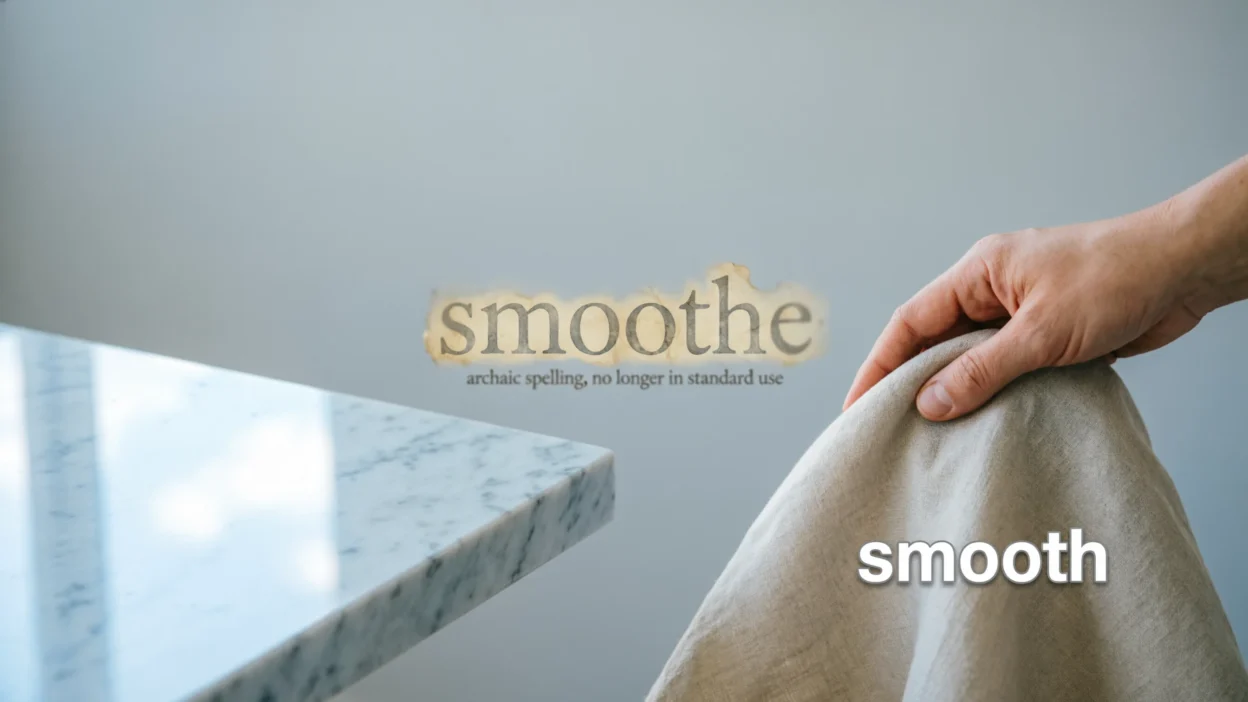
Smoothe is an older or less common verb variant of smooth. It also means “to make smooth,” but it rarely appears in modern English.
Examples of Smoothe
- He smoothe(d) the cloth carefully.
- The craftsman tried to smoothe the wood.
In modern writing, most native speakers and style guides strongly prefer smooth as the verb instead.
Smooth vs Smoothe: Main Difference
| Word | Part of Speech | Modern Usage |
|---|---|---|
| Smooth | Adjective and verb | Very common |
| Smoothe | Rare verb form | Uncommon/outdated |
Why “Smooth” Is Usually Correct
Modern English simplified usage over time. The shorter form smooth became the standard spelling for both adjective and verb uses.
Modern Preferred Forms
- smooth surface
- smooth hair
- smooth the fabric
- smooth over a problem
Most dictionaries now label smoothe as:
- archaic
- rare
- variant spelling
Common Mistakes People Make
Mistake 1: Adding an Extra “E”
Incorrect:
- Please smoothe the blanket.
Preferred:
- Please smooth the blanket.
Mistake 2: Thinking “Smoothe” Is More Formal
Actually, smooth is the standard modern form even in formal writing.
Mistake 3: Confusing Pronunciation
Both words are pronounced almost the same, which causes spelling confusion.
Pronunciation Difference
Smooth
Pronounced:
- smooth
Smoothe
Pronounced:
- usually the same as smooth
Because the pronunciation barely changes, many people mistakenly assume the spellings are interchangeable.
American vs British English Differences
There is no major difference between American and British English here.
Both American and British English Prefer:
- smooth
Smoothe in Modern English
- Rare in both varieties
- Mostly found in historical or poetic texts
Examples in Everyday Sentences
Correct Modern Sentences With “Smooth”
- The lotion makes your skin smooth.
- She smoothed the paper carefully.
- The singer has a smooth voice.
- We need to smooth out these problems.
Rare Sentences With “Smoothe”
- The old manuscript used the word smoothe.
Smooth in Common Expressions
Smooth Over
Meaning:
- to reduce tension or fix a problem
Example:
- They tried to smooth over the disagreement.
Smooth Sailing
Meaning:
- easy progress without problems
Example:
- The project was smooth sailing after approval.
Smooth Talker
Meaning:
- someone charming or persuasive
Example:
- He’s known as a smooth talker.
Easy Memory Trick
Here’s a simple way to remember:
- Smooth = standard modern spelling
- Smoothe = old-fashioned extra “e”
If you’re unsure, choose smooth almost every time.
Related Words and LSI Keywords
Here are related phrases connected to smooth or smoothe:
- smooth meaning
- smoothe definition
- smooth verb examples
- grammar mistakes
- English spelling tips
- commonly confused words
- smooth pronunciation
- adjective vs verb
- American vs British English
- correct spelling of smooth
FAQs About Smooth or Smoothe
Which spelling is correct: smooth or smoothe?
Smooth is the standard and correct modern spelling.
Is smoothe a real word?
Yes, but it is rare and considered outdated in most modern English usage.
Can smooth be a verb?
Yes. Smooth works as both an adjective and a verb.
Why do people confuse smooth and smoothe?
Because they sound almost identical.
Is smoothe used in British English?
It may appear occasionally in older texts, but modern British English strongly prefers smooth.
Should I ever use smoothe?
In most modern writing, it’s better to use smooth.
What does “smooth over” mean?
It means to fix or reduce conflict or difficulty.
Final Thoughts on Smooth vs Smoothe
The difference between smooth or smoothe is mostly about modern versus outdated usage. Today, smooth is the standard spelling used as both an adjective and a verb in American and British English. Although smoothe technically exists, it is rare and unnecessary in most writing.
If you want your English to sound natural, modern, and grammatically correct, choosing smooth is almost always the safest option. Understanding this distinction helps you avoid an uncommon spelling mistake and improves writing clarity.

In a city that never pauses, Madison Blake learned to feel deeply. She turns love into lines and heartbreak into something almost beautiful. Her words reveal what many hide soft truths, loud emotions, and everything in between writing for hearts still learning how to heal.